Rev. Michael W. Newman Mission & Ministry Facilitator, with Lutheran Church Missouri Synod Texas District challenges us to consider whether we will be an historic or contemporary, but don't answer too quickly!!
visit https://txlcms.org/will-you-be-a-historic-or-contemporary-lutheran/ to read the full article
Friday, May 19, 2017


You are not alone - a prayer book for victims of domestic violence
You Are Not Alone: A Prayer Book for Victims of Domestic Violence, is the newest resource from the LCMS Domestic Violence and Child Abuse Task Force. It is free of charge.
This devotional prayer book will help victims give voice to their heavenly Father in the midst of heartache and despair. As the author shares: This little booklet is a beginning, a first step on a long road. It provides written prayers for victims to use in different occasions, when they may not be able to identify what they’re feeling or what they need.
To download or preview a copy visit here
This devotional prayer book will help victims give voice to their heavenly Father in the midst of heartache and despair. As the author shares: This little booklet is a beginning, a first step on a long road. It provides written prayers for victims to use in different occasions, when they may not be able to identify what they’re feeling or what they need.
To download or preview a copy visit here
Tuesday, May 16, 2017
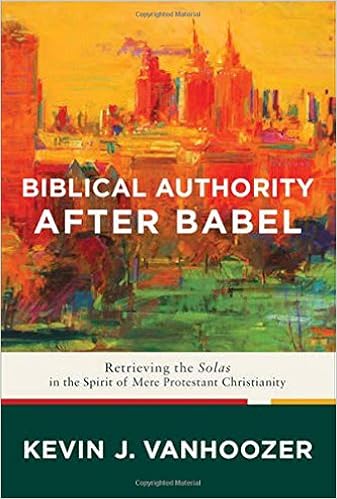
Book: Biblical authority after Babel
How the five solas can renew Biblical interpretation!!!
In recent years, notable scholars have argued that the Protestant Reformation unleashed interpretive anarchy on the church. Is it time to consider the Reformation to be a 500-year experiment gone wrong?
World-renowned evangelical theologian Kevin Vanhoozer thinks not. While he sees recent critiques as legitimate, he argues that retrieving the Reformation's core principles offers an answer to critics of Protestant biblical interpretation. Vanhoozer explores how a proper reappropriation of the five solas--sola gratia (grace alone), sola fide (faith alone), sola scriptura (Scripture alone), solus Christus (in Christ alone), and sola Deo gloria (for the glory of God alone)--offers the tools to constrain biblical interpretation and establish interpretive authority. He offers a positive assessment of the Reformation, showing how a retrieval of "mere Protestant Christianity" has the potential to reform contemporary Christian belief and practice.
This provocative response and statement from a top theologian is accessibly written for pastors, church leaders, and students.
Contents
1. Grace Alone: The Mere Protestant Ontology, Economy, and Teleology of the Gospel
Sola Gratia: What the Reformers Meant
Nature and/or Grace: Other Views
Triune Ontology and the Economy of Salvation
Sola Gratia for Bible, Church, and Interpretive Authority
2. Faith Alone: The Mere Protestant Principle of Authority
Sola Fide: What the Reformers Meant
Faith and/or Criticism: Other Views
The Principle of Authority
Sola Fide for Bible, Church, and Interpretive Authority
3. Scripture Alone: The Mere Protestant Pattern of Interpretive Authority
Sola Scriptura: What the Reformers Meant
Scripture and/or Tradition: Other Views
The Pattern of Authority
Sola Scriptura for Bible, Church, and Interpretive Authority
4. In Christ Alone: The Royal Priesthood of All Believers
Solus Christus: What the Reformers Meant
Christology and Ecclesiology: Other Views
The Royal Priesthood
Solus Christus for Bible, Church, and Interpretive Authority
5. For the Glory of God Alone: The Wealth of Holy Nations
Soli Deo Gloria: The Lord's Supper as a Test of Christian Unity
Church Unity: Other Views
Communion in the Church (and between Churches)
Soli Deo Gloria for Bible, Church, and Interpretive Authority
Conclusion: From Catholic Protestantism to Protestant Evangelicalism
"And in the Morning, It Was Leah!"
Protestant Evangelicalism: A Marriage Made in Heaven?
After Babel, Pentecost: The Households of God and the Spirit of Mere Protestant Christianity
The Gospel Alone: The Solas in the Pattern of Protestant Evangelical Interpretive Authority
Indexes
What others are saying
"In a season of Reformation remembrances, here comes a fresh appraisal of the core principles of historic Protestant Christianity. Written with conviction, nuance, and wisdom, this is Kevin Vanhoozer at his best--a treasure."
Timothy George, founding dean, Beeson Divinity School, Samford University; general editor, Reformation Commentary on Scripture
"The Reformation was about countering what was wrong in Catholicism, but its central principles, the five solas, are not only negations. Reformational Protestantism is also about being for something. The solas are therefore principles for shaping a robust theology. It is this constructive task that Vanhoozer has undertaken in this book, and he has done so with rigor, vigor, and an infectious enthusiasm."
David F. Wells, Distinguished Senior Research Professor, Gordon-Conwell Theological Seminary
"More than a rousing three cheers for the Reformation--though it is that--Kevin Vanhoozer's new book is a sparkling proposal for Protestant unity based on the five solas and also based on a differentiation between central gospel truths that are absolutely required and areas where disagreement should not divide Protestants denominationally. This is a constructive proposal for the next 500 years, rooted in an appreciation of the past 500. Catholic theologians like myself, seeking paths for deeper ecumenical dialogue, need to listen to Vanhoozer's rigorous, gracious, and erudite defense of the truth of Protestant Christianity."
Matthew Levering, James N. and Mary D. Perry Jr. Chair of Theology, Mundelein Seminary
"I've been waiting years for this book! In a theological landscape in which it's all too trendy to dismiss Protestantism, Vanhoozer takes a harder, braver route. He offers the church a compelling 'mere Protestantism' strong enough to give us hope going forward as we continue to seek, together with the tradition, faithfulness to God's good revelation to us in Scripture."
Beth Felker Jones, professor of theology, Wheaton College
"Kevin Vanhoozer properly calls for a Protestant ressourcement, encouraging us to rediscover some of the best wisdom from the early Reformers (think solas taken together) even as he challenges us to disentangle ourselves from some of the deeply problematic misunderstandings and outcomes that later arose in Protestant circles. He accomplishes what he sets out to do: look back creatively in order to move forward faithfully. If you are a Protestant and you love Scripture and the church, please read this book!"
Kelly M. Kapic, professor of theology, Covenant College
"Are rumors of Protestantism's demise greatly exaggerated? May it actually be the case that the authority, unity, and mission of the whole church could be served precisely by reengaging with the Reformation solas rather than running from them? While wrestling frankly with the Reformation's unintended consequences, Vanhoozer makes a penetrating argument that must be taken seriously."
Michael Horton, J. Gresham Machen Professor of Theology, Westminster Seminary California
"The authority of Scripture in the life of the church is a perennial theme of debate. In this book, Kevin Vanhoozer links the subject to the five solas of the Reformation era, explaining the part that each one of them plays in our interpretation and application of the Bible today. Half a millennium later, he shows how there is still life in these classical formulations and why they should be recovered by the church today. Biblical Authority after Babel will be a stimulating discussion starter and will help to shape the evolution of Protestant hermeneutics in the years ahead."
Gerald Bray, research professor of divinity, Samford University
"At a time when the terms 'evangelical' and 'catholic' both face bewildering internal and external pressures, Kevin Vanhoozer helps to shine Scripture's light on an authentically Protestant path forward. Amid newfound interest in the Reformation solas, this book's distinctive contribution lies in discerning their hermeneutical import. This approach challenged me to think afresh about the gospel, Scripture, and the church at several points."
Daniel J. Treier, Blanchard Professor of Theology, Wheaton College Graduate School
"Protestants in general, and evangelicals in particular, are often challenged to manifest a robust grasp of the catholicity of the church. The difficulty of such a task can be compounded by (mis)understandings of sola scriptura, as well as of the authority of--and authority in--the church. In Biblical Authority after Babel, Kevin Vanhoozer summons evangelical Protestants to squarely face these and related issues in their particular stream of Christianity, and he proposes a way forward by both faithfully and creatively drawing upon the five solas of the Reformation. This is an astute and constructively thought-provoking book."
W. David Buschart, professor of theology and historical studies, Denver Seminary
"Protestantism has been charged with many schisms and with spawning modern secularism and its varied ills. While some have sought solace in other folds, Kevin Vanhoozer responds not by looking elsewhere for another defense but by doubling down through retrieval of basic principles of Protestant theology. Further, he shows that those reformational solas were themselves retrievals of earlier biblical faith and practice. Readers of Vanhoozer have learned to expect to be charitably guided and imaginatively provoked, and this book delivers similar wisdom and provocation."
Michael Allen, associate professor of systematic and historical theology, Reformed Theological Seminary, Orlando
To buy the Biblical authority after Babel visit here
In recent years, notable scholars have argued that the Protestant Reformation unleashed interpretive anarchy on the church. Is it time to consider the Reformation to be a 500-year experiment gone wrong?
World-renowned evangelical theologian Kevin Vanhoozer thinks not. While he sees recent critiques as legitimate, he argues that retrieving the Reformation's core principles offers an answer to critics of Protestant biblical interpretation. Vanhoozer explores how a proper reappropriation of the five solas--sola gratia (grace alone), sola fide (faith alone), sola scriptura (Scripture alone), solus Christus (in Christ alone), and sola Deo gloria (for the glory of God alone)--offers the tools to constrain biblical interpretation and establish interpretive authority. He offers a positive assessment of the Reformation, showing how a retrieval of "mere Protestant Christianity" has the potential to reform contemporary Christian belief and practice.
This provocative response and statement from a top theologian is accessibly written for pastors, church leaders, and students.
Contents
- Introduction: Should the Church Repent or Retrieve the Reformation? Secularism, Skepticism, and Schism--Oh My!
- "By Their Fruits Ye Shall Know Them": Assessing a Revolution
- Narrating the Story of Protestantism
- Repenting the (Unintended) Iniquities of Our Reformation Fathers
- Fine-Tuning the Problem; Deepening the Dilemma
- Always Retrieving? "Ressourcing" the Debate about Interpretive Authority
- Why Mere Protestant Christianity Matters
1. Grace Alone: The Mere Protestant Ontology, Economy, and Teleology of the Gospel
Sola Gratia: What the Reformers Meant
Nature and/or Grace: Other Views
Triune Ontology and the Economy of Salvation
Sola Gratia for Bible, Church, and Interpretive Authority
2. Faith Alone: The Mere Protestant Principle of Authority
Sola Fide: What the Reformers Meant
Faith and/or Criticism: Other Views
The Principle of Authority
Sola Fide for Bible, Church, and Interpretive Authority
3. Scripture Alone: The Mere Protestant Pattern of Interpretive Authority
Sola Scriptura: What the Reformers Meant
Scripture and/or Tradition: Other Views
The Pattern of Authority
Sola Scriptura for Bible, Church, and Interpretive Authority
4. In Christ Alone: The Royal Priesthood of All Believers
Solus Christus: What the Reformers Meant
Christology and Ecclesiology: Other Views
The Royal Priesthood
Solus Christus for Bible, Church, and Interpretive Authority
5. For the Glory of God Alone: The Wealth of Holy Nations
Soli Deo Gloria: The Lord's Supper as a Test of Christian Unity
Church Unity: Other Views
Communion in the Church (and between Churches)
Soli Deo Gloria for Bible, Church, and Interpretive Authority
Conclusion: From Catholic Protestantism to Protestant Evangelicalism
"And in the Morning, It Was Leah!"
Protestant Evangelicalism: A Marriage Made in Heaven?
After Babel, Pentecost: The Households of God and the Spirit of Mere Protestant Christianity
The Gospel Alone: The Solas in the Pattern of Protestant Evangelical Interpretive Authority
Indexes
What others are saying
"In a season of Reformation remembrances, here comes a fresh appraisal of the core principles of historic Protestant Christianity. Written with conviction, nuance, and wisdom, this is Kevin Vanhoozer at his best--a treasure."
Timothy George, founding dean, Beeson Divinity School, Samford University; general editor, Reformation Commentary on Scripture
"The Reformation was about countering what was wrong in Catholicism, but its central principles, the five solas, are not only negations. Reformational Protestantism is also about being for something. The solas are therefore principles for shaping a robust theology. It is this constructive task that Vanhoozer has undertaken in this book, and he has done so with rigor, vigor, and an infectious enthusiasm."
David F. Wells, Distinguished Senior Research Professor, Gordon-Conwell Theological Seminary
"More than a rousing three cheers for the Reformation--though it is that--Kevin Vanhoozer's new book is a sparkling proposal for Protestant unity based on the five solas and also based on a differentiation between central gospel truths that are absolutely required and areas where disagreement should not divide Protestants denominationally. This is a constructive proposal for the next 500 years, rooted in an appreciation of the past 500. Catholic theologians like myself, seeking paths for deeper ecumenical dialogue, need to listen to Vanhoozer's rigorous, gracious, and erudite defense of the truth of Protestant Christianity."
Matthew Levering, James N. and Mary D. Perry Jr. Chair of Theology, Mundelein Seminary
"I've been waiting years for this book! In a theological landscape in which it's all too trendy to dismiss Protestantism, Vanhoozer takes a harder, braver route. He offers the church a compelling 'mere Protestantism' strong enough to give us hope going forward as we continue to seek, together with the tradition, faithfulness to God's good revelation to us in Scripture."
Beth Felker Jones, professor of theology, Wheaton College
"Kevin Vanhoozer properly calls for a Protestant ressourcement, encouraging us to rediscover some of the best wisdom from the early Reformers (think solas taken together) even as he challenges us to disentangle ourselves from some of the deeply problematic misunderstandings and outcomes that later arose in Protestant circles. He accomplishes what he sets out to do: look back creatively in order to move forward faithfully. If you are a Protestant and you love Scripture and the church, please read this book!"
Kelly M. Kapic, professor of theology, Covenant College
"Are rumors of Protestantism's demise greatly exaggerated? May it actually be the case that the authority, unity, and mission of the whole church could be served precisely by reengaging with the Reformation solas rather than running from them? While wrestling frankly with the Reformation's unintended consequences, Vanhoozer makes a penetrating argument that must be taken seriously."
Michael Horton, J. Gresham Machen Professor of Theology, Westminster Seminary California
"The authority of Scripture in the life of the church is a perennial theme of debate. In this book, Kevin Vanhoozer links the subject to the five solas of the Reformation era, explaining the part that each one of them plays in our interpretation and application of the Bible today. Half a millennium later, he shows how there is still life in these classical formulations and why they should be recovered by the church today. Biblical Authority after Babel will be a stimulating discussion starter and will help to shape the evolution of Protestant hermeneutics in the years ahead."
Gerald Bray, research professor of divinity, Samford University
"At a time when the terms 'evangelical' and 'catholic' both face bewildering internal and external pressures, Kevin Vanhoozer helps to shine Scripture's light on an authentically Protestant path forward. Amid newfound interest in the Reformation solas, this book's distinctive contribution lies in discerning their hermeneutical import. This approach challenged me to think afresh about the gospel, Scripture, and the church at several points."
Daniel J. Treier, Blanchard Professor of Theology, Wheaton College Graduate School
"Protestants in general, and evangelicals in particular, are often challenged to manifest a robust grasp of the catholicity of the church. The difficulty of such a task can be compounded by (mis)understandings of sola scriptura, as well as of the authority of--and authority in--the church. In Biblical Authority after Babel, Kevin Vanhoozer summons evangelical Protestants to squarely face these and related issues in their particular stream of Christianity, and he proposes a way forward by both faithfully and creatively drawing upon the five solas of the Reformation. This is an astute and constructively thought-provoking book."
W. David Buschart, professor of theology and historical studies, Denver Seminary
"Protestantism has been charged with many schisms and with spawning modern secularism and its varied ills. While some have sought solace in other folds, Kevin Vanhoozer responds not by looking elsewhere for another defense but by doubling down through retrieval of basic principles of Protestant theology. Further, he shows that those reformational solas were themselves retrievals of earlier biblical faith and practice. Readers of Vanhoozer have learned to expect to be charitably guided and imaginatively provoked, and this book delivers similar wisdom and provocation."
Michael Allen, associate professor of systematic and historical theology, Reformed Theological Seminary, Orlando
To buy the Biblical authority after Babel visit here
Book: Intrusive God, disruptive Gospel - Encountering the divine in the book of Acts
This engaging book guides readers through one of the most colorful books of the Bible, illuminating passages from Acts that show the Christian gospel expressing itself through the lives, speech, struggles, and adventures of Jesus's followers.
The book emphasizes the disruptive character of the Christian gospel and shows how Acts repeatedly describes God as upsetting the status quo by changing people's lives, society's conventions, and our basic expectations of what's possible.
Suited for individual and group study, this book by a New Testament scholar with a gift for popular communication asks serious questions and eschews pat answers, bringing Acts alive for contemporary reflection on the character of God, the challenges of faith, and the church.

Contents
Road Map: As You Read This Book
Acts 1:1-11: Waiting to Go
Acts 2:1-21: Making Sense of Things
Acts 2:22-41: Keeping an Old Promise
Road Map: Emerging Realities
Acts 3:11-26 and 4:5-12: The Ultimate Disruption
Acts 4:32-5:11: Communal Harmony as a Matter of Life or Death
Acts 6:1-7: Growth Brings Change--and Surprise
Acts 7:54-60: Using Violence to Keep God under Control
Road Map: Expansions
Acts 8:4-25: Spiritual Power, Spiritual Gift, and Spiritual Greed
Acts 8:26-40: Absurdly Good News
Acts 9:1-30: Seeing a Different Reality
Acts 9:32-43: The Work, Pain, and Tenderness of Christian Service
Acts 10:1-11:18: Old Boundaries Obliterated
Acts 12:1-19: Coming to Our Senses
Road Map: God Is Still Speaking
Acts 13:1-4: Called and Commissioned
Acts 14:8-20: Learning to Recognize God
Acts 15:1-35: Discerning God
Road Map: Very Public Disturbances
Acts 16:9-40: Battle of the Gods
Acts 17:16-34: The Gospel in the Flesh
Acts 18:1-17: When the Good News Escapes Attention
Acts 18:24-19:20: There's Power in the Name
Acts 19:21-41: Far-Reaching Disruptions
Road Map: The Witness Goes to Rome
Acts 21:1-6: Spirit-Led Disagreement
Acts 22:30-23:11: How to Be a Hero
Acts 25:1-12: The Gospel and the Empire
Acts 27-28: Open Horizons
What others are saying about Intrusive God, disruptive Gospel
"Matthew Skinner probes the book of Acts in an impressively effective way. He successfully negotiates the vexed issue of history and theology and offers a concise, accessible theological twist to every text he considers. His study shows the way in which the narrative text of Acts continues to be compelling for the church's self-understanding and mission."
Walter Brueggemann, Columbia Theological Seminary
"The book of Acts tells an exciting story that warrants the sort of engagement it is afforded here. Skinner takes us beyond the pedantic concerns of academia to experience the power of the story itself, to participate in its transformations and discoveries. Anyone who is spiritual and/or religious will benefit from this disruptive encounter with 'absurdly good news.'"
Mark Allan Powell, professor of New Testament, Trinity Lutheran Seminary
"There is no doubt that Acts is an entertaining read, full of the stuff of legend and tall tales. But what is a twenty-first-century Christian to do with such an unusual collection of stories about the early years of our faith? Enter Matthew Skinner, an internationally renowned scholar of Acts who has, for decades now, immersed himself in Acts--studying, writing, teaching, and preaching it. In this book, Skinner grips our attention, all of it, as he honestly, artfully, judiciously, concisely, and consistently connects our experience with the book of Acts. Chapter by chapter, Skinner teaches us, raises crucial questions--the raw, complex questions that we real readers have--and then offers bold conclusions born from his observations as both a scholar and a Christian."
Jaime Clark-Soles, associate professor of New Testament, Perkins School of Theology, Southern Methodist University
To buy Intrusive God, disruptive Gospel visit here
The book emphasizes the disruptive character of the Christian gospel and shows how Acts repeatedly describes God as upsetting the status quo by changing people's lives, society's conventions, and our basic expectations of what's possible.
Suited for individual and group study, this book by a New Testament scholar with a gift for popular communication asks serious questions and eschews pat answers, bringing Acts alive for contemporary reflection on the character of God, the challenges of faith, and the church.
Contents
Road Map: As You Read This Book
Acts 1:1-11: Waiting to Go
Acts 2:1-21: Making Sense of Things
Acts 2:22-41: Keeping an Old Promise
Road Map: Emerging Realities
Acts 3:11-26 and 4:5-12: The Ultimate Disruption
Acts 4:32-5:11: Communal Harmony as a Matter of Life or Death
Acts 6:1-7: Growth Brings Change--and Surprise
Acts 7:54-60: Using Violence to Keep God under Control
Road Map: Expansions
Acts 8:4-25: Spiritual Power, Spiritual Gift, and Spiritual Greed
Acts 8:26-40: Absurdly Good News
Acts 9:1-30: Seeing a Different Reality
Acts 9:32-43: The Work, Pain, and Tenderness of Christian Service
Acts 10:1-11:18: Old Boundaries Obliterated
Acts 12:1-19: Coming to Our Senses
Road Map: God Is Still Speaking
Acts 13:1-4: Called and Commissioned
Acts 14:8-20: Learning to Recognize God
Acts 15:1-35: Discerning God
Road Map: Very Public Disturbances
Acts 16:9-40: Battle of the Gods
Acts 17:16-34: The Gospel in the Flesh
Acts 18:1-17: When the Good News Escapes Attention
Acts 18:24-19:20: There's Power in the Name
Acts 19:21-41: Far-Reaching Disruptions
Road Map: The Witness Goes to Rome
Acts 21:1-6: Spirit-Led Disagreement
Acts 22:30-23:11: How to Be a Hero
Acts 25:1-12: The Gospel and the Empire
Acts 27-28: Open Horizons
What others are saying about Intrusive God, disruptive Gospel
"Matthew Skinner probes the book of Acts in an impressively effective way. He successfully negotiates the vexed issue of history and theology and offers a concise, accessible theological twist to every text he considers. His study shows the way in which the narrative text of Acts continues to be compelling for the church's self-understanding and mission."
Walter Brueggemann, Columbia Theological Seminary
"The book of Acts tells an exciting story that warrants the sort of engagement it is afforded here. Skinner takes us beyond the pedantic concerns of academia to experience the power of the story itself, to participate in its transformations and discoveries. Anyone who is spiritual and/or religious will benefit from this disruptive encounter with 'absurdly good news.'"
Mark Allan Powell, professor of New Testament, Trinity Lutheran Seminary
"There is no doubt that Acts is an entertaining read, full of the stuff of legend and tall tales. But what is a twenty-first-century Christian to do with such an unusual collection of stories about the early years of our faith? Enter Matthew Skinner, an internationally renowned scholar of Acts who has, for decades now, immersed himself in Acts--studying, writing, teaching, and preaching it. In this book, Skinner grips our attention, all of it, as he honestly, artfully, judiciously, concisely, and consistently connects our experience with the book of Acts. Chapter by chapter, Skinner teaches us, raises crucial questions--the raw, complex questions that we real readers have--and then offers bold conclusions born from his observations as both a scholar and a Christian."
Jaime Clark-Soles, associate professor of New Testament, Perkins School of Theology, Southern Methodist University
To buy Intrusive God, disruptive Gospel visit here
Report: Faith and belief in Australia by McCrindle
The Faith and Belief in Australia Report has been released by McCrindle and it shows that religion is not dead
Two in three identify with a religion or spirituality
More than two in three Australians (68%) follow a religion or have spiritual beliefs. Of those that do, almost half (47%) remain committed to the religion of their upbringing. The number of Australians who do not identify with a religion or spiritual belief, however, is on the rise with almost one in three (32%) not identifying with a religion. This study replicated the ABS Census question, but added in an option for ‘spiritual but not religious’. This had a response rate of 14% among Australians nationally, and the Christianity grouping was 45% (down from 61% in the 2011 Census).
More than half of Australians (52%) are open to changing their religious views given the right circumstances and evidence. Younger Australians are more open to changing their current religious views than older generations.
Religion and spirituality a popular topic of conversation
When gathering with friends, more than half of Australians (55%) often or occasionally talk about religion or spirituality. Generation Z (65%) are the most comfortable talking the topic, while the Baby Boomers are the least with 51% never talking about it with their friends.
A genuine faith the greatest attraction to a religion or spirituality
Observing people with genuine faith is the greatest attraction to investigating spirituality. Second is experiencing personal trauma or a significant life change. On the inverse, the top repellent to Australians investigating is public figures or celebrities who are examples of that faith. This is followed by miraculous stories of healings or supernatural occurrences.
Perceptions of Christianity
Australians most value Christian organisations for their work with those in need, specifically looking after people who are homeless, offering financial assistance/food relief programs and providing disaster relief (74%, 72% and 69% respectively). 8% of Australian adults (1.5 million) do not know any Christians, while for Generation Y this is almost one in ten. One in 29 Australians have never heard of Jesus.
To download the entire report visit http://mccrindle.com.au/the-mccrindle-blog/faith-and-belief-in-australia
Two in three identify with a religion or spirituality
More than two in three Australians (68%) follow a religion or have spiritual beliefs. Of those that do, almost half (47%) remain committed to the religion of their upbringing. The number of Australians who do not identify with a religion or spiritual belief, however, is on the rise with almost one in three (32%) not identifying with a religion. This study replicated the ABS Census question, but added in an option for ‘spiritual but not religious’. This had a response rate of 14% among Australians nationally, and the Christianity grouping was 45% (down from 61% in the 2011 Census).
More than half of Australians (52%) are open to changing their religious views given the right circumstances and evidence. Younger Australians are more open to changing their current religious views than older generations.
Religion and spirituality a popular topic of conversation
When gathering with friends, more than half of Australians (55%) often or occasionally talk about religion or spirituality. Generation Z (65%) are the most comfortable talking the topic, while the Baby Boomers are the least with 51% never talking about it with their friends.
A genuine faith the greatest attraction to a religion or spirituality
Observing people with genuine faith is the greatest attraction to investigating spirituality. Second is experiencing personal trauma or a significant life change. On the inverse, the top repellent to Australians investigating is public figures or celebrities who are examples of that faith. This is followed by miraculous stories of healings or supernatural occurrences.
Perceptions of Christianity
Australians most value Christian organisations for their work with those in need, specifically looking after people who are homeless, offering financial assistance/food relief programs and providing disaster relief (74%, 72% and 69% respectively). 8% of Australian adults (1.5 million) do not know any Christians, while for Generation Y this is almost one in ten. One in 29 Australians have never heard of Jesus.
To download the entire report visit http://mccrindle.com.au/the-mccrindle-blog/faith-and-belief-in-australia
Subscribe to:
Posts (Atom)